Why is the median cubital vein used for venipuncture?
 Sarah Scott
 .
Regarding this, where does the median cubital vein drain blood from?
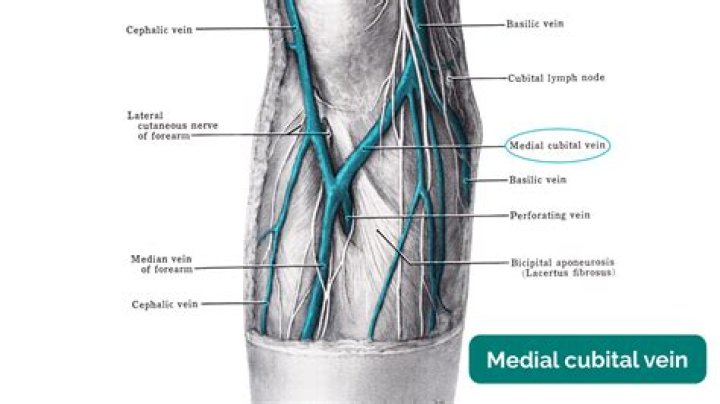
Venous anatomy of the region The venae comitantes drain into the median cubital vein via a constant branch near the elbow. The superficial forearm veins drain into the cephalic, basilic, and median cubital veins (see Figure 25.3).
Also, what separates the median cubital vein from the median nerve? The median nerve then courses medial to the brachial artery (Figure 3.2). In the cubital fossa, the median nerve lies behind the median cubital vein and under the bicipital aponeurosis, providing a branch to the elbow joint. It is separated from the ulnar artery by the deep or ulnar head of that muscle.
Besides, what are the 3 most common veins used in phlebotomy?
“Thanks Fizzy Ology! Let's get to our bonus question: Name the three most common arm veins used in phlebotomy.” Median cubital, basalmic, and radial veins.
What is the vein of choice for venipuncture?
Median cubital vein
Related Question Answers
How do you find the median of a cubital vein?
The median cubital vein, also known as the median basilic vein, is located in the triangular area inside the elbow. If you lay your hand down palm up on a desk, you'll see the underside of your elbow. Right in the crease there you'll see right where this vein runs through.What happens if you Cannulate an artery?
If you cannulate an artery, there should be a pumping of bright red blood back into your angiocath, which would not be seen when you cannulate a vein. Intraarterial injection frequently causes arterial spasm and eventual loss of limb, usually from gangrene.What are the four major veins in the antecubital space?
Anatomically the superficial veins of the cubital fossa are classified into four types according to the presence of the median cubital vein (MCV) or median antebrachial vein. Type I: The median antebrachial vein is dominant and joins both cephalic vein (CV) and basilic vein (BV) in the cubital region.Is basilic vein a deep vein?
The basilic vein is a common access site for performing digital subtraction venography. Deep veins — The deep veins of the upper extremity include the paired ulnar, radial, and interosseous veins in the forearm; paired brachial veins of the upper arm; and axillary vein.Where is the metacarpal vein?
Dorsal metacarpal veins are the three veins that are located on the back of the hand. These veins are made up of the dorsal digital veins, which are the veins that are located on adjacent sides of the second, third, and fourth fingers along the dorsal interossei.How do you find your veins?
Use veins on top of the hand, top of the forearm, or inside the elbow. Veins inside the elbow are large but hard to reach by yourself. It is easier to reach the smaller veins on top of your hand. Feel veins to see how big they are and in which direction they go.How many ulnar veins are there?
The ulnar vein is one of the two major deep veins of the forearm, along with the radial vein. As is usual in the upper and lower limbs, there are often two veins (venae comitantes) that run on either side of the ulnar artery and anastomose freely with each other.Which vein should be avoided for venipuncture?
Although the larger and fuller median cubital and cephalic veins of the arm are used most frequently, the basilic vein on the dorsum of the arm or dorsal hand veins are also acceptable for venipuncture. Foot veins are a last resort because of the higher probability of complications.Why can't they draw blood from my veins?
Dehydration, loss of vein patency, and low blood pressure are typical issues, while arthritis, injury, or stroke may give elderly patients a limited range of motion, making it impossible to hyperextend their arms to survey for available veins. “The biggest problem is fragile, delicate veins that blow.How can I strengthen my IV veins?
Warm up washcloths with hot water – make sure it isn't so hot that it will scald the patient – and layer the warm, damp cloths along the patient's arm to the elbow. Wrap the arm with the bed pad, and allow the patient to sit for ten minutes. In this time, it should warm the arm enough to bring the veins to the surface.Which vein is best for drawing blood?
For adult patients, the most common and first choice is the median cubital vein in the antecubital fossa. Commonly referred to as the antecubital or the AC it can be found in the crevice of the elbow between the median cephalic and the median basilic vein.What is the most important step in doing a venipuncture?
The most important step in the performance of venipuncture is identifying the patient. Even though you may feel like this is very clear and feel like you would not mistake the patient, it happens quite often. It is always best to thoroughly check the patient's identity before beginning anything else.Where is the Antebrachial region?
the antebrachial region encompassing the forearm, the carpal region encompassing the wrist, the palmar region encompassing the palm, the digital/phalangeal region encompassing the fingers.Why are the basilic and median basilic veins the last choice of veins to use for venipuncture?
The basilic vein should be considered only as a final alternative. It is more difficult to access than the other veins of the antecubital area and its proximity to artery, nerves and tendons increases the possibility of injury to the patient. The median cubital and cephalic veins are better choices.What is the fold of the arm called?
Is there a name for the inside of the arm bend; the crease inside your elbow? A fossa is a shallow depression from the Latin word for “ditch” so that cubital fossa literally means “elbow crease.”What two structures underlie the basilic vein?
The basilic vein originates from the dorsal venous network of the hand and ascends the medial aspect of the upper limb. At the border of the teres major, the vein moves deep into the arm. Here, it combines with the brachial veins from the deep venous system to form the axillary vein.How long can you leave a tourniquet on for venipuncture?
one minute