Why do plates collide? | ContextResponse.com
 Noah Mitchell
.
Keeping this in consideration, why do tectonic plates collide?
When the tectonic plates collide the underlying plate is consumed into the Earth's mantle, creating a hot magma that erupts from volcanoes on the surface of the overlying plate. These volcanoes form a volcanic arc.
Similarly, what happens when oceanic plates collide with continental plates? Ocean-Continent Collisions When an oceanic and a continental plate collide, eventually the oceanic plate is subducted under the continental plate due to the high density of the oceanic plate. As time goes on the hot magma rising upward from the subduction zone causes further compression of the mountain belt.
In this manner, what will happen if two continental plates collide?
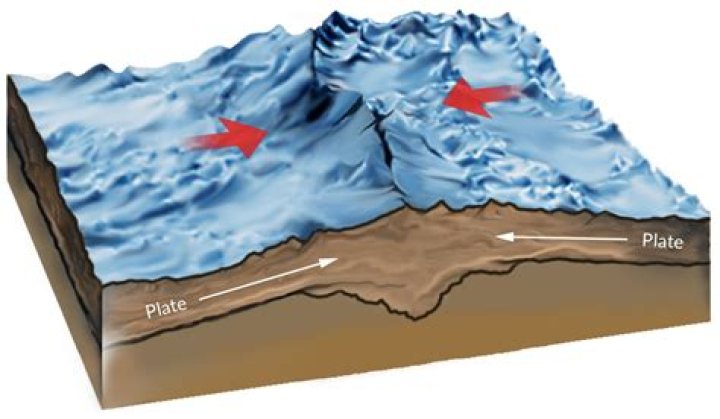
Instead, a collision between two continental plates crunches and folds the rock at the boundary, lifting it up and leading to the formation of mountains and mountain ranges.
What happens when tectonic plates hit each other?
When oceanic or continental plates slide past each other in opposite directions, or move in the same direction but at different speeds, a transform fault boundary is formed. No new crust is created or subducted, and no volcanoes form, but earthquakes occur along the fault.
Related Question Answers
What is the ring of fire and where is it located?
Pacific Ocean
Do divergent boundaries cause earthquakes?
Yes, a divergent plate boundary can create earthquakes. There are two primary types of divergent boundaries; spreading ridges in the oceans, and rift valleys on land. They create earthquakes in different ways. Divergent plate boundaries on land (rift valleys) occur in much thicker crust, so they act quite differently.What do plates float on?
Answer and Explanation:Tectonic plates float on the asthenosphere. The asthenosphere is immediately below the top layer of Earth's surface (lithosphere).When two plates converge the result is called a?
Convergent BoundariesThe place where two plates come together, or converge, is called a convergent boundary (kun vur junt). When two plates converge, the result is called a collision. When two plates collide, the density of the plates determines which one comes out on top.What forms when two oceanic plates collide?
When two oceanic plates converge, the denser plate will subduct under the plate that is less dense, creating a deep sea trench at the point of subduction. As the subducted plate goes deeper into the mantle, the mantle material above it starts to melt to become magma.How do convergent boundaries cause earthquakes?
Earthquakes at convergent plate boundaries mark the motions of subducting lithosphere as it plunges through the mantle (Figure below). Eventually the plate heats up enough deform plastically and earthquakes stop.What landforms are created by divergent boundaries?
Two landforms that are created from divergent boundaries are rift valleys and mid-oceanic ridges.How do the Earth's tectonic plates move?
Plates at our planet's surface move because of the intense heat in the Earth's core that causes molten rock in the mantle layer to move. It moves in a pattern called a convection cell that forms when warm material rises, cools, and eventually sink down.What are the 4 types of plate boundaries?
Plate Boundaries: Convergent, Divergent, Transform- Divergent: extensional; the plates move apart. Spreading ridges, basin-range.
- Convergent: compressional; plates move toward each other. Includes: Subduction zones and mountain building.
- Transform: shearing; plates slide past each other. Strike-slip motion.
What two plates collided to form the Himalayas?
Continental/Continental: The HimalayasThe Himalayan mountain range and Tibetan plateau have formed as a result of the collision between the Indian Plate and Eurasian Plate which began 50 million years ago and continues today.How do plates interact when they collide?
Tectonic plate interactions are of three different basic types: Divergent boundaries are areas where plates move away from each other, forming either mid-oceanic ridges or rift valleys. These are also known as constructive boundaries. Convergent boundaries are areas where plates move toward each other and collide.What are the two tectonic plates called?
Tectonic plates are pieces of Earth's crust and uppermost mantle, together referred to as the lithosphere. The plates are around 100 km (62 mi) thick and consist of two principal types of material: oceanic crust (also called sima from silicon and magnesium) and continental crust (sial from silicon and aluminium).What is oceanic plate and continental plate?
Explanation: oceanic plates are formed at divergent boundaries mainly at mid ocean ridges. The material that is poured out are basaltic lave in nature. Basalt is denser and heavier than the granite that makes up continental plates. The Continental plates are much less dense than the Oceanic plates.What is created when two plates pull apart?
A divergent boundary occurs when two tectonic plates move away from each other. Along these boundaries, earthquakes are common and magma (molten rock) rises from the Earth's mantle to the surface, solidifying to create new oceanic crust.What happens when two continental plates collide quizlet?
When 2 continental plates collide, they squeeze the crust upward into mountain ranges. When a oceanic and continental plate collide, the oceanic plate moves below the continental plate. The oceanic plate melts and forms magma and sinks back into the mantle.What happens when plates are bent?
Bending of plates, or plate bending, refers to the deflection of a plate perpendicular to the plane of the plate under the action of external forces and moments. Once the stresses are known, failure theories can be used to determine whether a plate will fail under a given load.What causes continental drift?
The causes of continental drift are perfectly explained by the plate tectonic theory. The earth's outer shell is composed of plates that move a little bit every year. Heat coming from the interior of the earth triggers this movement to occur through convection currents inside the mantle.What major plate is the largest?
Pacific plate