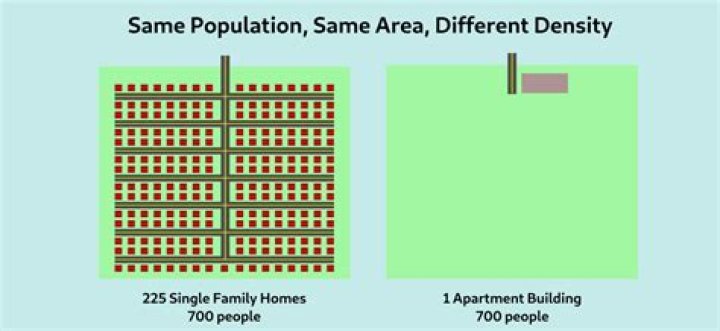
What is meant by density of population?
 Rachel Newton
.
Similarly, you may ask, what is population density example?
It is calculated by dividing the population bythe area. For example, France has a population of60,561,200, and an area of 551,695 square kilometres, so itspopulation density is about 109.8 persons per squarekilometre. A number of factors can affect populationdensity. For example, the climate.
Beside above, what is meant by population density quizlet? Population Density. The number of individuals ofa species per unit of area or volume at a given time. Growth Rate.The rate of change of a population's size, expressed inpercent per year. Dispersal.
Correspondingly, how do you find the population density?
To calculate the population density, you willdivide the population by the size of the area. Thus,Population Density = Number of People/Land Area. The unit ofland area should be square miles or square kilometers. You can usesquare feet or meters if you are finding the density of asmallish space.
What are the types of population density?
1a) Describe the three types of densityused in population geography. The three types ofdensity are physiological, arithmetic, and agriculture.Physiological density calculates the amount of people perarable square kilometer of land. Arithmetic density is theamount of people per square kilometer of land.
Related Question Answers
What are the advantages of population density?
The benefits of population densityIn other words, denser cities lead to better transportaccessibility, and this, in turn, means better access to jobs, lesstraffic congestion and fewer carbon emissions.What is mean by population density?
Definition of PopulationDensityIn biology, populations are groups ofindividuals belonging to the same species that live in the sameregion at the same time. Population density is a measure ofthe number of organisms that make up a population in adefined area.What factors affect the density of a population?
Major factors influencing the distribution and density ofpopulation are described as under:- Terrain: Terrain of land is a potent factor which influencesthe concentration and growth of population.
- Climate:
- Soil:
- Water Bodies:
- Mineral Resources:
- Industries:
- Transport:
- Urbanization:
What are the two types of population distribution?
Three basic types of population distributionwithin a regional range are (from top to bottom) uniform, random,and clumped.How is population measured?
Two important measures of a population arepopulation size, the number of individuals, andpopulation density, the number of individuals per unit areaor volume. Ecologists estimate the size and density ofpopulations using quadrats and the mark-recapturemethod.What is population structure?
Population pyramids show the structure ofa population by comparing relative numbers of people indifferent age groups. The shape of a population pyramid cantell us a lot about an area's population.How is population calculated?
where Gr equals the growth rate, N equals the change inpopulation over the entire time period as a number ofindividuals, and t equals the time period, usually a number ofyears. Gr is also expressed as a number of individuals. N iscalculated by subtracting the initial population fromthe current population.What causes overpopulation?
Overpopulation results from an increased birthrate, decreased death rate, the immigration to a new ecologicalniche with fewer predators, or the sudden decline in availableresources. Therefore, overpopulation describes a situationin which a population in a given ecosystem limit the resourcesavailable for survival.What is the ideal population density?
Ideal population-density. There is a lotof talk about at which level should the population of anygiven country be. However, it has been established that theideal population density is between 50-100 people per squarekm. Perhaps over that until 150 is bearable but not verydesirable.How do you find area?
To find the area of a rectangle multiplyits height by its width. For a square you only need to findthe length of one of the sides (as each side is the same length)and then multiply this by itself to find thearea.What is age distribution?
Age distribution, also called AgeComposition, in population studies, the proportionate numbers ofpersons in successive age categories in a given population.A population with persistently high fertility, for instance, has alarge proportion of children and a small proportion of agedpersons.Is high population density good?
Higher population density has definitely enabledeconomic and social development. But, at the same time the growthin the overall population of the planet is threatening toexacerbate many environmental and economic population, suchas over-fishing, higher pollution, loss of habitat andstress on water.Which country has the highest population density?
Macau