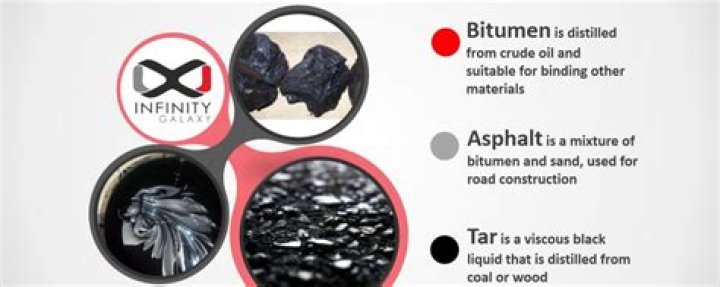
What is difference between bitumen and tar?
 Matthew Sanders
.
Then, what is the difference between tar asphalt and bitumen?
The main difference between Tar and Asphalt is that the Tar is a substance and Asphalt is a sticky, black and highly viscous liquid or semi-solid form of petroleum; bitumen variety. Tar can be produced from coal, wood, petroleum, or peat.
Beside above, which is more ductile bitumen or tar? As of now, there are no results available for the ductility of Tar. Moreover, Ductility is measure of elasticity and adhesiveness of bitumen, hence Ductility is defined only for bitumen among all road binding materials.
Keeping this in view, why Bitumen is used instead of coal tar?
The bitumen have less affinity to water compared to tar. Tar have a chemical composition with more carbon content than bitumen. This result tar to have higher viscosity, making it less workable compared to bitumen. The tar also possess a higher susceptibility to temperature compared with bitumen.
What are the three types of bitumen?
Three types of bituminous emulsions are available, which are Rapid setting (RS), Medium setting (MS), and Slow setting (SC). Bitumen emulsions are ideal binders for hill road construction.
Related Question Answers
Is bitumen a tar?
Bitumen is a naturally occurring dark substance composed of aromatic hydrocarbons and can occur in solid and liquid forms. Tar is a viscous black liquid which is derived through the process of destructive distillation. It can be derived either from coal or petroleum sources, or from wood.Is tar used in asphalt?
Asphalt is a material that's usually described as a sticky, black and hugely thick substance that's comparably the semi-solid form of petroleum. It's the actual liquid binder that keeps asphalt together. Some roads are sealed with bitumen and then overlaid with an aggregate. Tar is a substance that's derived from coal.What is tar used for?
Tar is used in treatment of the skin disease psoriasis, where coal tar is the most effective. Tar is a general disinfectant. Petroleum tar was also used in ancient Egyptian mummification circa 1000 BC. Tar was a vital component of the first sealed, or "tarmac", roads.What is bitumen used for?
Most refined bitumen is used in the construction industry. Mainly, it serves its use in paving and roofing applications. 85% of all bitumen is used as a binder in asphalt for roads, runways, parking lots, and foot paths.Is bitumen flammable?
Given that pure bitumen, tar and their mixtures are flammable at high temperatures, and work with them because dangerous flammability test method for flash point and burning of the bitumen is therefore set. If the solid or semi-solid bitumen is heated it to 176 ° C and melt.What is asphalt called in Australia?
Modern terminologyBitumen mixed with clay was usually called "asphaltum", but the term is less commonly used today. In Australian English, the word "asphalt" is used to describe a mix of construction aggregate. In American English, "asphalt" is equivalent to the British "bitumen".What is tar made of?
Tar is a dark brown or black viscous liquid of hydrocarbons and free carbon, obtained from a wide variety of organic materials through destructive distillation. Tar can be produced from coal, wood, petroleum, or peat. Tar-like products can also be produced from other forms of organic matter, such as peat.Why is coal tar good for skin?
This medication is used on the skin to treat the itching, scaling, and flaking due to skin conditions such as psoriasis or seborrheic dermatitis. Coal tar belongs to a class of drugs known as keratoplastics. It works by causing the skin to shed dead cells from its top layer and slow down the growth of skin cells.How bitumen is obtained?
Petroleum Bitumen, normally called “Bitumen” or “Asphalt” is produced by refining crude oil. Used as a binder in road-building products, it is a very viscous, black or dark brown material. Finally, Bitumen is obtained by vacuum distillation or vacuum flashing of atmospheric residue from the vacuum distillation column.What is cutback bitumen?
Cutback Bitumen ( Liquid Bitumen ) is Bitumen that is dissolved in a solvent . Typical solvents include Naptha, gasoline and kerosene, white spirit etc. The type of solvent controls the curing time while the amount determines the viscosity of the Cutback Bitumen.What is bitumen grade?
The penetration is measured in mm and it indicates the relative hardness of the bitumen. Higher the penetration, softer is the bitumen. A penetration of 0.6 to 0.7 mm indicates 60/70 penetration grade bitumen. Various viscosity grades of asphalt cement (bitumen) were evolved as AC-30 Grade, AC-20 Grade and AC-10 Grade.Is Tar man made?
Tar is a sticky black liquid made of thick oil. It is a natural substance, oozing out of the ground in places like the La Brea tar pits. Most tar is produced from coal as a byproduct of coke production, but it can also be produced from petroleum, peat or wood.Is bitumen a fossil fuel?
The bitumen tar sands are located in three areas of Alberta, Canada and have become a major global source for fossil fuel extraction. Bitumen has a different composition than conventional oil, making it more expensive, difficult, and harmful to extract as well as transport.How do you make bitumen emulsion?
To create an asphalt emulsion, the asphalt and water are blended by a colloid mill, which uses spinning discs to break the asphalt up into droplets so it can be dispersed into the water. Some water droplets may also end up inside the asphalt droplets, making this a “water-in-oil-in-water” or double emulsion.Where is bitumen and tar normally used?
Bitumen is used to waterproof boats as well as to seal and bind materials used to construct buildings. It also has medicinal properties. Tar is a viscous black liquid which is derived through the process of destructive distillation. It can be derived either from coal or petroleum sources, or from wood.Why is tar used on roads?
Tars are residues from the destructive distillation of organic substances such as coal, wood, or petroleum and are Bituminous materials or asphalts are extensively used for roadway construction, primarily because of their excellent binding characteristics and water proofing properties and relatively low cost.How do you test bitumen?
The following tests are usually conducted to evaluate different properties of bituminous materials.- Penetration test.
- Ductility test.
- Softening point test.
- Specific gravity test.
- Viscosity test.
- Flash and Fire point test.
- Float test.
- Water content test.