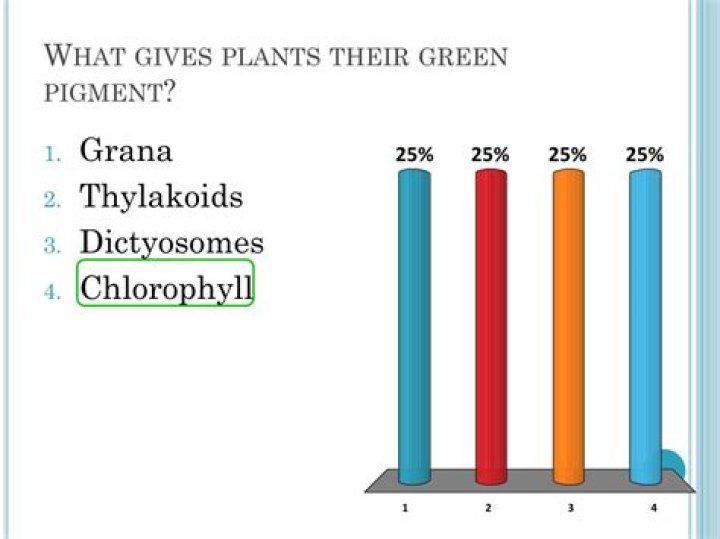
Chlorophyll is a green pigment that gives most plants their color. The reason that it is green is because it absorbs other colors of light such as red and blue, so in a way the green light is reflected out since the pigment does not absorb it..
Then, what gives plants the green color?
Sure, plants are green because their cells contain chloroplasts which have the pigment chlorophyll which absorbs deep-blue and red light, so that the rest of the sunlight spectrum is being reflected, causing the plant to look green.
Secondly, what substance gives chloroplasts their green color? Chlorophyll
Just so, what makes chlorophyll green?
Green plants are green because they contain a pigment called chlorophyll. As shown in detail in the absorption spectra, chlorophyll absorbs light in the red (long wavelength) and the blue (short wavelength) regions of the visible light spectrum. Green light is not absorbed but reflected, making the plant appear green.
Why are some plants not green?
All photosynthesizing plants have a pigment molecule called chlorophyll. This molecule absorbs most of the energy from the violet-blue and reddish-orange part of the light spectrum. It does not absorb green, so that's reflected back to our eyes and we see the leaf as green.
Related Question Answers
What plants are not green?
Many plants are selected as ornamentals because of their red leaves— purple smoke bush and Japanese plums and some Japanese maples, to name just a few. Obviously they manage to survive quite well without green leaves. At low light levels, green leaves are most efficient at photosynthesis.Why the leaf is green?
Chlorophyll is a pigment found in the thylakoid membranes of the chloroplasts in the leaves. This is why plants are green. The simple answer is that plants are green because they have green chloroplasts (organelles that carry out photosynthesis). Chlorophyll is a pigment that absorbs red and blue light.Why are plants green key?
The simple answer is that plants are green because they have green Chloroplasts (organelles that carry out . Answer Plants appear green because their cells contain chloroplasts, which contains chlorophyll ,then gives plants green pigment in order to survive.What color is chlorophyll A?
Plants and green algae (plants are really advanced green algae) contain chlorophyll a (which is teal-green), chlorophyll b (which is yellow-green), and beta-carotene (which is yellow), thus giving them a green color.Why can't chlorophyll absorb green light?
Green plants are green because they contain a pigment called chlorophyll. As shown in detail in the absorption spectra, chlorophyll absorbs light in the red (long wavelength) and the blue (short wavelength) regions of the visible light spectrum. Green light is not absorbed but reflected, making the plant appear green.Why does chlorophyll not absorb green?
The process of photosynthesis produces oxygen, which is released by the plant into the air. Chlorophyll gives plants their green color because it does not absorb the green wavelengths of white light. That particular light wavelength is reflected from the plant, so it appears green.Are plants green because the sun is green?
Sure, plants are green because their cells contain chloroplasts which have the pigment chlorophyll which absorbs deep-blue and red light, so that the rest of the sunlight spectrum is being reflected, causing the plant to look green.What is chlorophyll good for?
People use chlorophyll as medicine. Common sources of chlorophyll used for medicine include alfalfa, algae, and silkworm droppings. Chlorophyll is used for bad breath and reducing colostomy odor. Chlorophyll is also used for constipation, "detoxification," and wound healing.What happens when Chlorophyll absorbs light?
What happens when light is absorbed by a molecule such as chlorophyll? The energy from the light excites an electron from its ground energy level to an excited energy level (Figure 19.7). This high-energy electron can have several fates.Is liquid chlorophyll good for you?
Chlorophyll plays an important role in making plants green and healthy. It also has vitamins, antioxidants, and therapeutic properties that may benefit your body. You can get chlorophyll from plants or supplements. Although chlorophyll is fat-soluble, it may not survive digestion long enough for absorption.Is chlorophyll a protein?
Chlorophyll molecules are specifically arranged in and around pigment protein complexes called photosystems which are embedded in the thylakoid membranes of chloroplasts. Because of chlorophyll's selectivity regarding the wavelength of light it absorbs, areas of a leaf containing the molecule will appear green.Is chlorophyll green in color?
Chlorophyll is a green pigment that gives most plants their color. The reason that it is green is because it absorbs other colors of light such as red and blue, so in a way the green light is reflected out since the pigment does not absorb it.What is green pigment in plants?
Chlorophyll: the pigment that gives plants their green color and allows them to absorb sunlight Chloroplast: a part of a cell found in plants that converts light energy into energy plants can use (sugar). Other living organisms such as algae also have cells that contain chloroplasts.What 2 types of cells contain chloroplasts?
Chloroplasts are organelles found in plant cells and eukaryotic algae that conduct photosynthesis.Where is chloroplast found?
The chloroplast is located throughout the cytoplasm of the cells of plant leaves and other parts depending on the type of plant. Actually, you can see where in a plant the chloroplasts are because chloroplasts are what make the plant appear green. Therefore wherever there is green on a plant there are chloroplasts.How do green plants obtain their food?
Plants make food in their leaves. The leaves contain a pigment called chlorophyll, which colors the leaves green. Chlorophyll can make food the plant can use from carbon dioxide, water, nutrients, and energy from sunlight. During the process of photosynthesis, plants release oxygen into the air.Why are leaves green even when other pigments are present?
Why are the leaves green even though other pigments are present? Plants are green because their cells contain chloroplasts which hold chlorophyll. The pigment chlorophyll absorbs red and blue colors so that the color that is reflected is green.Why are plants green not black?
For a plant, the pigment chlorophyll absorbs blue and red light and reflects green light as you mentioned. Since evolution has chosen chlorophyll as the best way to make sugar out of light, a plant doesn't need to have the many different pigments that would make it black.What does chloroplast look like?
Chloroplast StructureMost chloroplasts are oval-shaped blobs, but they can come in all sorts of shapes such as stars, cups, and ribbons. Some chloroplasts are relatively small compared to the cell, while others may take up the majority of the space inside the cell. 
 Joseph Russell