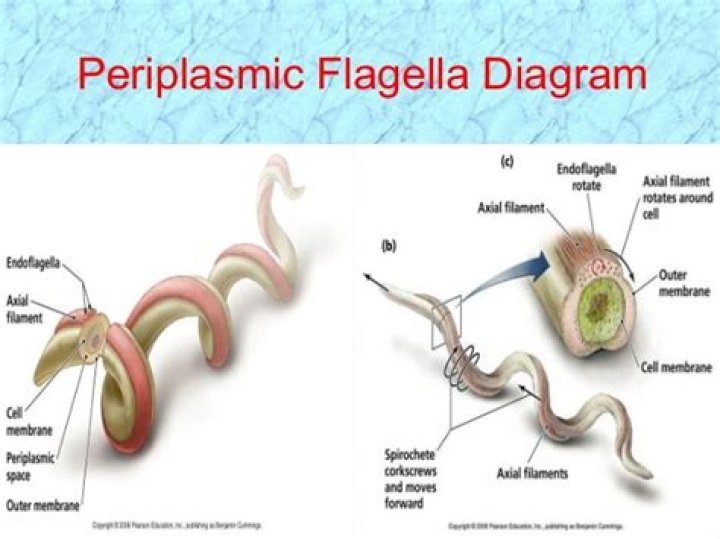
Cellular component - Periplasmic flagellumSpirochetes have a flagellum that resides inside the cell within the periplasmic space. The number of flagella varies from species to species. The rotation of these structures results in specific movements of the cell body, which in turn enable the locomotion of the cell..
Also question is, do spirochetes have flagella?
Like many other bacteria, the spirochetes use long, helical appendages known as flagella to move; however, the spirochetes enclose their flagella in the periplasm, the narrow space between the inner and outer membranes.
Similarly, what kind of flagella do spirochetes have? Spirochetes are unique in that they have endocellular flagella (axial fibrils, or axial filaments), which number between 2 and more than 100 per organism, depending upon the species. Each axial fibril attaches at an opposite end and winds around the cell body, which is enclosed by an envelope.
Besides, what is in the periplasmic space?
The periplasmic space is the region between these membranes that includes a variety of enzymes and functions, including the oxidation and quality control of proteins. Also within the periplasmic space is a layer of crosslinked sugars and amino acids termed peptidoglycan, which surrounds the cell.
What is an Endoflagella?
Endoflagella are the special flagella of spirochetes that spiral tightly around the cell instead of protruding into the environment. Together, these endoflagella form an axial filament that wraps around the cell and rotates, enabling it to “corkscrew” through its medium.
Related Question Answers
Where do spirochetes live?
Spirochetes are a group of six genera of spiral-shaped, slender bacteria of varying length. They are either free-living or host-associated. They are found in the human oral cavity, gastrointestinal tracts of humans, mammals, insects, and in marine environments.What gives spirochetes shape?
spirochaete. spirochaete Any nonrigid corkscrew-shaped bacterium that moves by means of flexions of the cell, produced by a series of rotatory axial fibrils underlying the cell's outer sheath. Most spirochaetes are Gram-negative (see Gram's stain), anaerobic, and feed on dead organic matter.Are spirochetes parasites?
The ecological roles of spirochetes are varied; the group includes both aerobic and anaerobic species, and both free-living and parasitic forms. Perhaps the best-known spirochetes are those which cause disease. These include syphilis and Lyme disease, as well as other less well-known ones.Are spirochetes visible?
They are visible with light microscopy and have the cork-screw shape typical of all spirochetes. This process, called antigenic variation, allows the spirochete to evade the host immune system and cause relapsing episodes of fever and other symptoms.Can you see spirochetes?
Distinctive Features: Spirochetes are rarely seen in peripheral blood and are bacteria of the order Spirochaetales. Spirochetes appear as small, thin, corkscrew-shaped, extracellular organisms.Are spirochetes contagious?
The short answer is no. There's no direct evidence that Lyme disease is contagious. Lyme disease is a systemic infection caused by spirochete bacteria transmitted by black-legged deer ticks. The corkscrew-shaped bacteria, Borrelia burgdorferi, are similar to the spirochete bacteria that cause syphilis.Who discovered spirochetes?
In the early 1980s, Dr. Burgdorfer was analyzing deer ticks from Long Island that were suspected to have caused spotted fever when he stumbled on something unexpected under his microscope: spirochetes, disease-causing bacteria shaped like corkscrews.How do spirochetes move?
Spirochetes are corkscrew-shaped bacteria. They have modified flagella that are encased in a membrane, wrap around the cell, and attach to both ends. The arrangement of the flagella causes the organism to rotate when it moves.What is Periplasm made of?
periplasm. periplasm (periplasmic space) The zone between the cytoplasmic membrane and the outer membrane in Gram-negative bacteria. It contains a thin layer of peptidoglycan, has a gel-like consistency, and contains various types of proteins concerned with the cell's metabolism.What are pili used for?
The first external structure is the pilus (plural: pili). A pilus is a thin, rigid fiber made of protein that protrudes from the cell surface. The primary function of pili are to attach a bacterial cell to specific surfaces or to other cells.Why is lipid A toxic?
Lipid A is a lipid component of an endotoxin held responsible for the toxicity of gram-negative bacteria. It is the innermost of the three regions of the lipopolysaccharide (LPS), also called endotoxin molecule, and its hydrophobic nature allows it to anchor the LPS to the outer membrane.Where is endotoxin produced?
ENDOTOXIN. Endotoxin, the lipopolysaccharide component of the outer cell wall of gram-negative bacteria, is present in large quantities in the large intestine of healthy horses. Endotoxins are released into the immediate surroundings when gram-negative bacteria undergo rapid proliferation or die.Do archaea have Periplasm?
Structurally, archaea are most similar to gram-positive bacteria. Most have a single plasma membrane and cell wall, and lack a periplasmic space; the exception to this general rule is Ignicoccus, which possess a particularly large periplasm that contains membrane-bound vesicles and is enclosed by an outer membrane.What is periplasmic space in bacteria?
The region between cytoplasmic and outer membrane of the Gram-negative bacteria is called the periplasmic space. It contains a concentrated gel-like matrix, the periplasm.Where is periplasmic space found?
The periplasm is the space between the inner and outer membrane in Gram-negative bacteria. In Gram-positive bacteria a smaller periplasmic space is found between the inner membrane and the peptidoglycan layer.Does gram negative have teichoic acid?
Teichoic acids aren't found in Gram-negative bacteria because they aren't. They are a major constituent of the Gram-positive cell wall and they contribute to wall stability in those organisms. They are a major constituent of the Gram-positive cell wall and they contribute to wall stability in those organisms.What is the purpose of teichoic acid?
The main function of teichoic acids is to provide rigidity to the cell-wall by attracting cations such as magnesium and sodium. Teichoic acids also assist in regulation of cell growth by limiting the ability of autolysins to break the β(1-4) bond between the N-acetyl glucosamine and the N-acetylmuramic acid.How many types of spirochetes are there?
The Spirochaetaceae family includes four genera: Spirochaeta, Cristispira, Treponema, and Borrelia. Two of these genera—Spirochaeta and Cristispira—are considered free-living and commensal, respectively. The other three genera—Treponema, Borrelia, and Leptospira—contain pathogenic species.Do all bacteria have flagella?
The most common appendages used for getting around, however, are flagella (singular: flagellum). These tail-like structures whip around like propellers to move cells through watery environments. Yes, flagella are present not only in bacteria and archaea, but on some eukaryotic cells as well. 
 Isabella Wilson