Bromine (Z=35), which has 35 electrons, can be found in Period 4, Group VII of the periodic table. Since bromine has 7 valence electrons, the 4s orbital will be completely filled with 2 electrons, and the remaining five electrons will occupy the 4p orbital..
Keeping this in view, what is the orbital diagram of bromine?
Bromine has 35 electrons, so it will have 35 arrows placed in its orbital-filling diagram as in figure 13. The order bottom to top, adding the electrons to the various sublevels, is 1s, 2s, 2p, 3s, 3p, 4s, 3d and 4p. Notice that the 3d sublevel is filled after the 4s and before the 4p.
Additionally, why does BR have 7 valence electrons? Valency is the combining power of an element. It is determined by the number of valence electrons in the outermost shell of the element. Bromine has atomic number 35, which means it has 7 electrons in its valence shell. It needs one more electron to attain the noble gas configuration.
One may also ask, how many shells does bromine have?
Bromine is a member of the halogen family of elements. Its companions include fluorine, chlorine, and iodine. Like the other halogens, bromine has seven electrons in its outer shell and is very reactive. You will find bromine in many salt compounds with alkali metals.
How many valence electrons are in a BR − ion?
Below is the Lewis dot structure for a neutral bromine atom, which has seven valence electrons. Below is the Lewis dot structure for a Br− ion, which has eight valence electrons. The extra valence electron gives it a negative charge.
Related Question Answers
What is bromine reactive to?
Chemical propertiesBromine is a very reactive element. While it is less reactive than fluorine or chlorine, it is more reactive than iodine. It reacts with many metals, sometimes very vigorously. For instance, with potassium, it reacts explosively.How many bonds can bromine have?
Bromine will normally form one covalent bond.Bromine, which belongs to group 17 and period four of the Periodic Table, has seven outer shell or valence electrons.Is bromine a metal or nonmetal?
Is Bromine a Metal or a Nonmetal? Bromine is a nonmetal element. It takes a liquid form at normal room temperature and has a brownish-red color in both its gaseous and liquid state.Where is bromine found?
Bromine is found naturally in the earth's crust and in seawater in various chemical forms. Bromine can also be found as an alternative to chlorine in swimming pools. Products containing bromine are used in agriculture and sanitation and as fire retardants (chemicals that help prevent things from catching fire).How many total electrons does bromine have?
35 electrons
What type of bond does bromine have?
Hydrogen needs only two electrons to fill its valence, which it gets through the covalent bond. The bromine has an octet because it has two electrons from the H-Br bond and six more electrons, two in each lone pair on Br.What is bromine used for?
Bromine is used in many areas such as agricultural chemicals, dyestuffs, insecticides, pharmaceuticals and chemical intermediates. Some uses are being phased out for environmental reasons, but new uses continue to be found. Bromine compounds can be used as flame retardants.What is the flammability of bromine?
Bromine is not combustible but it is a STRONG OXIDIZER which will enhance the burning of other materials. Extinguish fire using an agent suitable for type of surrounding fire. POISONOUS GASES ARE PRODUCED IN FIRE Use water spray to keep fire-exposed containers cool.Why is bromine dangerous?
Bromine is corrosive to human tissue in a liquid state and its vapors irritate eyes and throat. Bromine vapors are very toxic with inhalation. Humans can absorb organic bromines through the skin, with food and during breathing. These bromines can damage the nervous system and the thyroid gland.What color is 2% bromine?
Elemental bromine is a fuming reddish-brown liquid at room temperature (melts at (−7.2 °C, boils at 58.8 °C). Why does bromine water decolourise when it reacts with cyclohexene?What is the Colour of bromine?
Bromine is a chemical element with symbol Br and atomic number 35. It is the third-lightest halogen, and is a fuming red-brown liquid at room temperature that evaporates readily to form a similarly coloured gas. Its properties are thus intermediate between those of chlorine and iodine.Who founded bromine?
Antoine Jérôme BalardCarl Jacob LöwigWhy is it called bromine?
The name bromine comes from the Greek word "bromos" for stench, according to Los Alamos National Laboratory. The reddish-brown liquid evaporates readily into a red vapor with a strong odor resembling chlorine.What bromine smells like?
Bromine is a toxic, reddish-brown liquid at room temperature. It has a very strong odor that can irritate the eyes, lungs, and throat. It is hard to describe the smell but most people say that it smells like chemicals.Why do shells start with K?
He noticed that atoms appeared to emit two types of X-rays. As it turns out, the K type X-ray is the highest energy X-ray an atom can emit. It is produced when an electron in the innermost shell is knocked free and then recaptured. This innermost shell is now called the K-shell, after the label used for the X-ray.What is so special about bromine?
Bromine is the only nonmetallic element that is liquid at ordinary temperatures. It is a dense, reddish-brown liquid which evaporates easily at room temperature to a red vapor with a strong, chlorine-like odor. Bromine is less reactive than chlorine or fluorine but more reactive than iodine.What ion is bromine most likely to form?
Bromine, like all halogens, has 7 valence electrons. Thus it readily will form an ionic bond with group 1 elements like Hydrogen, Sodium or Potssium to form HBr, NaBr or KBr, respectively, as this allows Bromine to “feel” a complete octet of (8) valence electrons, a very stable configuration.How many electrons are in the N 2 orbit of bromine?
Bromine (Z=35), which has 35 electrons, can be found in Period 4, Group VII of the periodic table. Since bromine has 7 valence electrons, the 4s orbital will be completely filled with 2 electrons, and the remaining five electrons will occupy the 4p orbital.What is valence configuration?
The electrons that occupy the outermost shell of an atom are called valence electrons. Valence electrons are important because they determine how an atom will react. By writing an electron configuration, you'll be able to see how many electrons occupy the highest energy level. 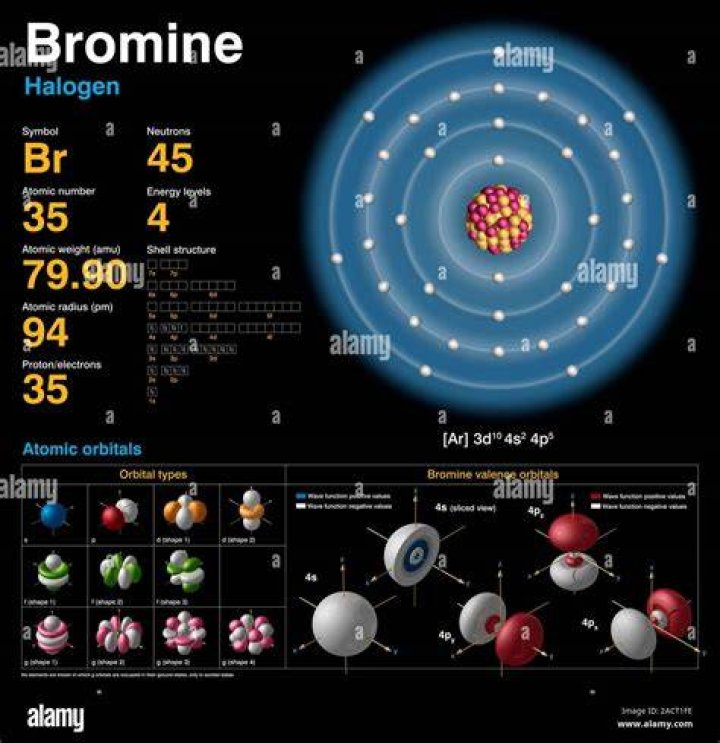
 Rachel Newton