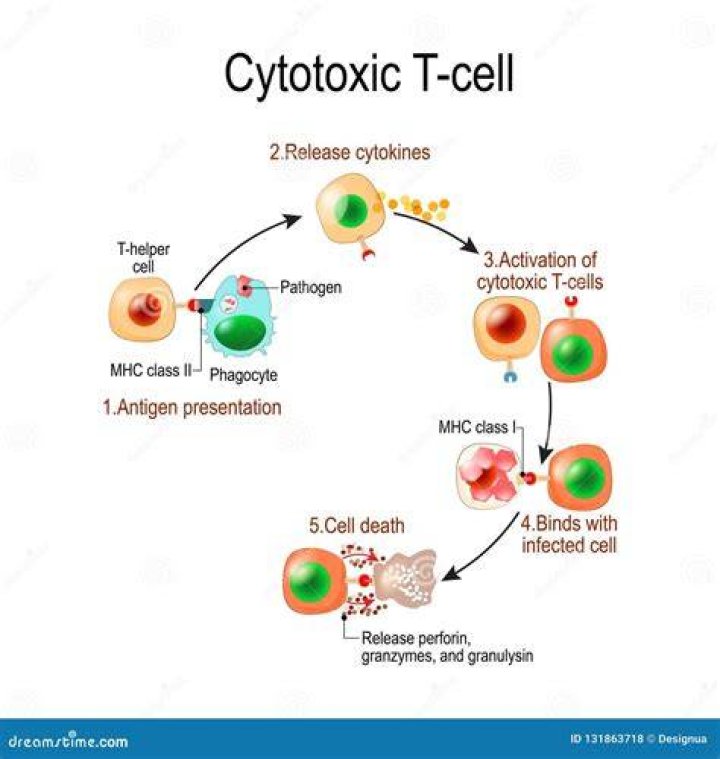
How do cytotoxic T cells kill target cells?
 Benjamin Ward
 .
Similarly, it is asked, how do cytotoxic T cells respond to infected cells?
Cytotoxic T lymphocytes and NK cells play an essential role in the defense against viruses, by promoting killing of virus-infected cells through two key mechanisms: FAS-mediated apoptosis and release of cytotoxic molecules such as granzyme through pores in the membrane that are generated by perforin.
Also, how do CTLs kill target cells? CTLs can kill target cells by producing cytotoxic cytokines, particularly TNF and LT. Apoptosis of a target cell can be induced by the binding of TNF produced by a CTL to TNF receptor 1 (TNFR1) on the target cell surface. LT, which also binds to TNFR1, has a similar effect.
Subsequently, question is, how are T cytotoxic cells activated?
Cytotoxic T cells are activated by dendritic cells that express antigen-loaded class I molecules. Dendritic cells ingest intact cells (cross-priming) or free antigens. The second signal is provided by CD28 on T cells interacting with B7-1 on antigen-presenting cells.
How do cytotoxic lymphocytes kill their targets?
Cytotoxic T lymphocytes mediate lysis of target cells by various mechanisms, including exocytosis of lytic proteins (perforin, granzymes) and receptor-ligand binding of Fas/APO molecules. The majority of CTL also bears CD8 molecules, thought to bind reversibly to target cell receptor.
Related Question Answers
How do you activate T cells naturally?
Healthy ways to strengthen your immune system- Don't smoke.
- Eat a diet high in fruits and vegetables.
- Exercise regularly.
- Maintain a healthy weight.
- If you drink alcohol, drink only in moderation.
- Get adequate sleep.
- Take steps to avoid infection, such as washing your hands frequently and cooking meats thoroughly.
What is the difference between natural killer cells and cytotoxic T cells?
NK cells have cytotoxic granules already formed and are ready to kill target cells. NK cells kill cells that have antibody bound to the surface. NK cells target cells that have lost expression of MHC molecules, such as tumor cells or virus-infected cells.How do you activate T cells?
Helper T cells become activated when they are presented with peptide antigens by MHC class II molecules, which are expressed on the surface of antigen-presenting cells (APCs). Once activated, they divide rapidly and secrete cytokines that regulate or assist the immune response.How long do cytotoxic T cells live?
These methods were later used to confirm that memory T cells live for six months or less in healthy humans (Westera et al., 2013), whereas naive T cells can live for up to nine years (Vrisekoop et al., 2008).Where are cytotoxic T cells found in the body?
T cells are so called because they are predominantly produced in the thymus. They recognise foreign particles (antigen) by a surface expressed, highly variable, T cell receptor (TCR). There are two major types of T cells: the helper T cell and the cytotoxic T cell.How do T cells kill infected cells?
Killer T-cells find and destroy infected cells that have been turned into virus-making factories. To do this they need to tell the difference between the infected cells and healthy cells with the help of special molecules called antigens. Killer T-cells are able to find the cells with viruses and destroy them.How do T cells recognize cancer cells?
Antigens from the cancer cells are then taken up and presented on the cell surface of special immune cells called antigen-presenting cells (APCs) so that other immune cells can “see” the antigens of interest. In the lymph nodes, the APCs activate the T-cells and teach them to recognize the tumor cells.How can cytotoxic T cells Recognise a cell as being cancerous?
Most cytotoxic T cells express T-cell receptors (TCRs) that can recognize a specific antigen. An antigen is a molecule capable of stimulating an immune response, and is often produced by cancer cells or viruses.How do B and T cells work?
T cells and B cellsT cells (thymus cells) and B cells (bone marrow- or bursa-derived cells) are the major cellular components of the adaptive immune response. T cells are involved in cell-mediated immunity, whereas B cells are primarily responsible for humoral immunity (relating to antibodies).What are B cells and what is their role in immune system?
Produced in the bone marrow, B cells migrate to the spleen and other secondary lymphoid tissues where they mature and differentiate into immunocompetent B cells. Part of the adaptive immune system, B cells are responsible for generating antibodies to specific antigens, which they bind via B cell receptors (BCR).What are the natural killer cells?
Natural killer cells (also known as NK cells, K cells, and killer cells) are a type of lymphocyte (a white blood cell) and a component of innate immune system. They serve to contain viral infections while the adaptive immune response is generating antigen-specific cytotoxic T cells that can clear the infection.What are the functions of B cells?
B cells, also known as B lymphocytes, are a type of white blood cell of the small lymphocyte subtype. They function in the humoral immunity component of the adaptive immune system by secreting antibodies.Do B cells have MHC?
The Class I MHC molecules are found on all nucleated cells in the body (including cells expressing Class II MHC such as antigen presenting cells, dendritic cells, macrophages, and B cells), but are not found on non-nucleated cells such as red blood cells.What does a cytotoxic T cell do?
Cytotoxic CD8 T cells carry out their killing function by releasing two types of preformed cytotoxic protein: the granzymes, which seem able to induce apoptosis in any type of target cell, and the pore-forming protein perforin, which punches holes in the target-cell membrane through which the granzymes can enter.How do helper T cells and cytotoxic T cells work together?
Helper T-cells produce cytotoxic T-cells. Helper T-cells produce cytokines to activate other cells of the immune system. Cytotoxic T-cells attack abnormal body cells, while helper T-cells attack virally infected cells. Helper T-cells produce cytokines to activate other cells of the immune system.How do B cells recognize antigens?
Unlike T cells that recognize digested peptides, B cells recognize their cognate antigen in its native form. The B cell receptor used in recognition can also be secreted to bind to antigens and initiate multiple effector functions such as phagocytosis, complement activation, or neutralization of receptors.How do T cells work in the immune system?
Helper T-cells stimulate B-cells to make antibodies and help killer cells develop. Killer T-cells directly kill cells that have already been infected by a foreign invader. T-cells also use cytokines as messenger molecules to send chemical instructions to the rest of the immune system to ramp up its response.Do killer T cells kill bacteria?
Cytotoxic T-lymphocytes (CTL) are famous for their ability to kill tumor, allogeneic and virus-infected cells. However, an emerging literature has now demonstrated that CTL also possess the ability to directly recognize and kill bacteria, parasites, and fungi.What does CTL stand for in immunology?
Cytotoxic T-Lymphocyte