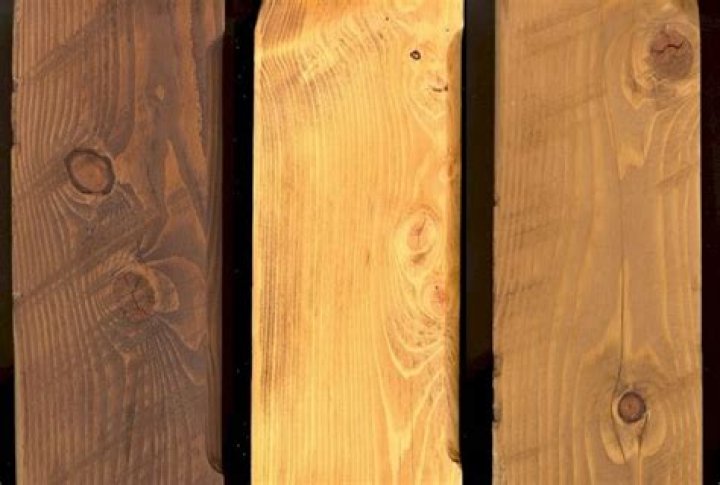
Does Hemlock stain like pine?
 Noah Mitchell
.
Also to know is, is Hemlock better than pine?
It is much stronger and harder than pine. It is used as cribbing (jacking timbers) and in situations requiring high strength. Green hemlock is very heavy but is easily worked with tools. It has a uniform texture, is easily worked with tools, shrinks little and is straight grained.
Likewise, can PINE be stained? Staining Pine Antique pine often has a dark, mellow color. Pine is hard to stain for a couple of reasons. First, its grain is unevenly dense. Typical wood stains cause grain reversal because they color only the porous earlywood; they can't penetrate the dense latewood.
Regarding this, what kind of stain do you use on Pine?
And I always prefer to use Rust-Oleum wood stain on pine because you can literally paint it on like paint (just not quite as thick as paint) and it'll still dry completely in a relatively short amount of time, and you can cover up as much of that crazy pine grain as possible.
What Colour is hemlock wood?
Eastern Hemlock. Color/Appearance: Heartwood is light reddish brown. Sapwood may be slightly lighter in color but usually isn't distinguished from the heartwood. The conspicuous growth rings can exhibit interesting grain patterns on flatsawn surfaces.
Related Question Answers
Is Hemlock more expensive than pine?
Pine is the not as strong as fir or hemlock. Pine has more knots, but it's more affordable that hemlock or fir. Pine has the advantage of aesthetics if you like rustic lumber for paneling, cabinets or furniture.Are hemlock trees worth money?
&bsp; For the tree grower, hemlock in 8 foot to 16 foot length logs is worth $. 25 a board foot when brought to the saw mill. In the case of dying hemlocks, the landowner has to pay the logger to come cut the tree and haul it off, which most likely will cost him more than the value of the wood.What are the disadvantages of ash wood?
Disadvantages/ConsPoor Wear Resistance: The Ashwood is having a poor water resistant and that is why it cannot be used in the outdoor areas. Poor Stability: The ashwood is having a very low density and that is why it get cracked easily. Durability: The ashwood is not very much durable and can be destroyed easily.Is Hemlock good for outdoor use?
Because the western variety is resin-free, it accepts any paint, stain, or clear finish with more satisfying results than the eastern species. Don't use either hemlock species outdoors without preservative treatment. Due to its strength and wear-resistance, hemlock also becomes reliable ladders and stair components.Is a hemlock a pine?
Hemlock is evergreen tree that belongs to the pine family. There are around 10 species of hemlock that are native to America (4 species) and Asia (remaining 6 species). Hemlock inhabits dense, moist habitats that are characterized by dry, rocky soil.Is Hemlock A strong wood?
The wood of eastern hemlock is moderately light in weight, moderately hard, coarse grained, uneven in texture, and inclined to splinter when machined. Although moderately low in bending strength and shock resistance, eastern hemlock can be used in construction for light framing, sheathing, subflooring, and roofing.How can you tell the difference between pine and hemlock?
Quick Key to Identifying Hemlock. Needles have 2 white "racing stripes" on the underside. Fir needles have similar stripes. Conical to egg-shaped (more or less); fine branches give this tree a lacier appearance than spruce, fir or pine.How good is hemlock lumber?
Once dry, it is considered stable. Unlike its forest companions, Hemlock is a non-durable, non-resinous species not suitable for most exterior applications. Western Hemlock is an important commercial and construction species. It is most often used as a general construction wood in studs, roof decking and plywood.What is the best finish for pine wood?
The best finish for pine is polyurethane and epoxy products, gel stains and oil-based or latex paints followed by clear topcoats, such as varnish or shellac. Which types of these to use will often depend on what the wood is being used for.Do I need to sand pine before staining?
Sanding preparation. On most raw woods, start sanding in the direction of the grain using a #120-150 grit paper before staining and work up to #220 grit paper. Soft woods such as pine and alder: start with #120 and finish with no finer than #220 (for water base stains) and 180 grit for oil base stains.How do you prepare pine for staining?
Steps- Sand the wood with a low-grit sandpaper to remove inconsistencies.
- Use a higher grit sandpaper to smooth the surface.
- Scrub the wood with a soft sponge to raise the grain.
- Brush on two coats of wood conditioner.
- Wipe off the excess conditioner.
- Leave the wood to dry for 2-3 hours.
How many coats of stain can you apply?
2 coats
How do you darken pine?
If your table has a clear finish, remove it first to properly darken the stain.- Sand the clear finish off of the pine table using an orbital sander with 100-grit paper.
- Sand the table again by hand using a hand-sanding block with 100-grit sandpaper.
- Dip a soft cloth into an open can of oil stain.